Describe how the seat will be used
Start with the body and the setting, not the fabric book. A dining banquette supports a relatively upright posture; a lounging seat may need deeper support and a different back angle. A helm seat has another set of operational demands. Record cushion dimensions, likely users, intended sitting duration and the relationship between finished seat height and nearby tables.
Then map the exposure. An interior seat beside an opening door may receive wet clothing and strong sunlight even though it is not classed as exterior furniture. Identify whether cushions can be lifted, where water could collect and how the space is ventilated when the vessel is unattended. A luxurious hand-feel does not answer these questions.
Separate density from firmness
Foam density describes mass per unit volume. Firmness describes resistance to compression under a defined test. They are related to construction choices but are not interchangeable measures of quality. Ask the supplier to identify both, together with the intended application and any relevant performance documentation. Compare cushions in their proposed thickness rather than judging a small block alone.
Layered constructions can provide a softer initial feel over firmer support. The cover tension and cushion geometry also affect the result. A full-size sitting trial is therefore more informative than squeezing a sample. Include the real base or suspension because a cushion tested on a rigid bench can feel different on a flexible support.
Choose a cover for more than abrasion
Leather varies with hide selection, finish and treatment. Coated textiles vary with their face chemistry, backing and construction. Woven fabrics bring their own differences in stretch, snagging, lightfastness and cleaning. High abrasion figures can be useful, but they do not predict every failure mode or establish resistance to sunscreen, dye transfer, moisture or repeated disinfection.
Request product-specific cleaning guidance and ask how marks can be treated without changing sheen or colour. For removable covers, confirm whether removal is intended for laundering, professional cleaning or access only. A zip does not automatically make a cover washable. Shrinkage, lining construction and the behaviour of adjacent materials still matter.
Draw the seam as a functional detail
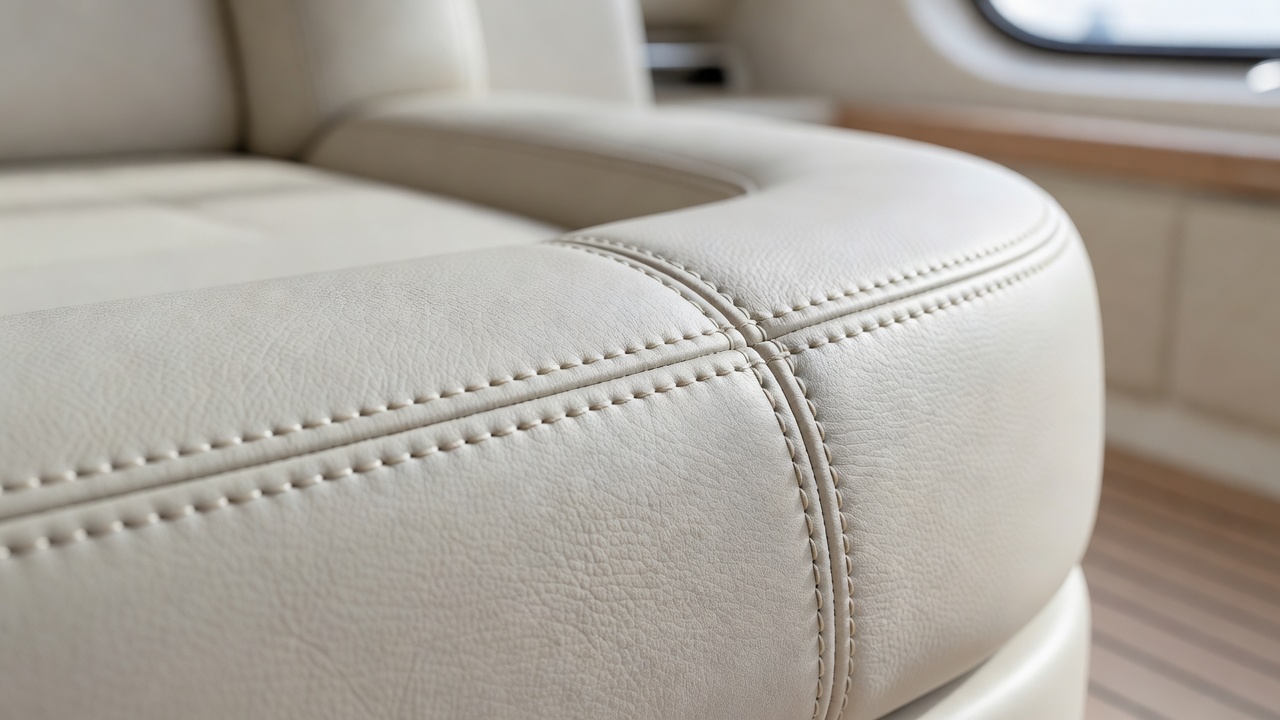
A seam determines where a cover bends, how tension is distributed and where moisture might enter. Thread type, stitch formation, seam allowance and any reinforcement deserve deliberate selection. Decorative piping can define an edge, but it can also create an additional wear line or a place where cleaning residue gathers.
Where wetting is expected, consider the entire water path rather than assuming a water-resistant face makes the cushion waterproof. Needle holes, zips and the underside may admit moisture. Drainage and drying require an assembly-level decision, including the foam, support and ventilation below. Avoid solving one problem with an impermeable layer that creates another by trapping moisture.
“Comfort is a relationship between layers, not a property printed on the cover sample.”
— Moxbejellytornado editorial workshop note
Keep fire evidence attached to the build
Where a vessel requires upholstery fire-performance evidence, identify the applicable regime with the responsible project team before ordering. A test on a cover alone may not represent the finished seat. The combination of cover, interliner, foam and other components can matter, as can the test method and the scope of a certificate.
Domestic upholstery tests and marine requirements should not be treated as automatic equivalents. EN 1021 addresses specified ignition sources for upholstered furniture; the IMO FTP Code provides a different regulatory context. Which evidence is acceptable depends on the vessel and approving authority. Do not substitute a foam or backing merely because the visible fabric remains unchanged.
Plan replacement before delivery
Label cushions discreetly so their location and orientation remain clear after cleaning. Keep a seam drawing, material references and instructions for removing the cover without tearing hidden attachments. Where possible, preserve patterns or digital cutting information so a replacement can be made without reverse-engineering a stretched original.
Finally, agree what spare material is sensible and how it should be stored. Exposure changes colour over time, so new material may not exactly match a sun-aged neighbour even when the original reference is available. A maintainable scheme anticipates that reality through replaceable groups and thoughtful seam positions. That is a quieter form of luxury than promising a surface will never change.
Read the product, then the evidence
- Sunbrella: product-specific fabric and care information; use the instructions for the exact textile.
- Ultrafabrics: coated upholstery material information and care resources. Check individual product documentation rather than extrapolating across a range.
- Kvadrat: textile specifications, maintenance guidance and explanations of performance characteristics.
- ISO: catalogue information for ISO 12947 textile abrasion methods. Abrasion testing alone does not demonstrate marine suitability.
- BSI and the IMO: routes to EN 1021 and FTP Code information respectively. Confirm the applicable requirements with the approving parties.
Continue to The Last Millimetre Aboard, or read the workshop questions.