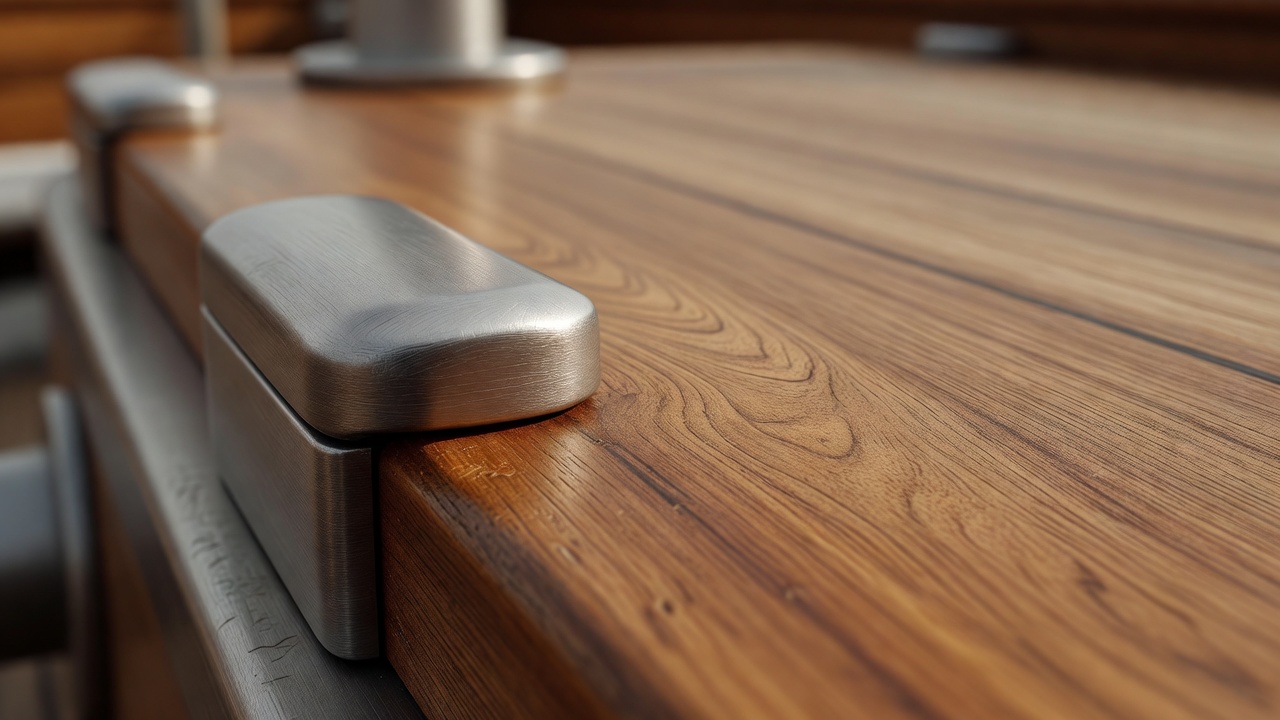
Map the exposure, not just the room
The inside of a yacht is not one uniform environment. A shaded wardrobe, a sunlit saloon table and a washbasin surround have different duties. Mark likely wetting, direct sunlight, warm equipment, cleaning frequency and contact with cosmetics or food on the drawings. This small exercise is more useful than assigning every visible surface the same broad marine label.
Condensation deserves particular attention at cooler boundaries and around poorly ventilated enclosures. A surface may remain dry in normal use while moisture develops behind it. Drainage, airflow and access for inspection are design matters; a highly resistant topcoat cannot correct a persistent hidden moisture source.
Specify the coating as a system
For timber, ask about preparation, sealer, build coats, topcoat and the treatment of edges and cut-outs. Compatibility between layers matters. So do cure conditions and the time allowed before wrapping, transport or cleaning. An attractive sample prepared under ideal conditions does not prove that a rushed installation will behave the same way.
High gloss can emphasise grain and depth, but also makes local distortion and repair boundaries more visible. A satin finish changes the appearance of reflections rather than making a material maintenance-free. Establish an acceptable reference sample, then assess it under both daylight and the proposed cabin lighting. Retain written cleaning instructions for the exact system.
Stone needs a support conversation
Natural stone is variable: veining, pores and fissures can affect appearance and fabrication. Thin stone bonded to a backing may reduce mass, but it creates an assembly whose adhesive, edge and support conditions need assessment. Sink openings, overhangs and local impacts are not minor details merely because the visible slab is thin.
Engineered mineral surfaces and ceramic products bring different fabrication limits and chemical sensitivities. Avoid treating stain resistance, heat resistance and crack resistance as interchangeable claims. Ask what each claim was tested against, how joints are formed and whether a damaged section can be repaired or must be replaced.
| Surface family | Interface to examine | Maintenance question |
|---|---|---|
| Coated timber | Cut edges, joints, reverse face | Can a local repair be blended? |
| Stone or ceramic | Backing, support, cut-outs | Which cleaners and sealers are permitted? |
| Metal trim | Fasteners, adjacent metals, trapped water | Can the finish tolerate polishing? |
| Decorative laminate | Edge seals, adhesive, heat exposure | Can the panel be replaced without damage nearby? |
Read the metal junction
Stainless steel is a family of alloys, not a promise that staining or corrosion cannot occur. Grade, fabrication, surface condition and the environment influence performance. Dissimilar metals can create galvanic corrosion when an electrically conductive liquid connects them. Isolation details may help, but must be selected with the project team rather than improvised with any available washer.
Decorative plating and coloured metal finishes introduce further questions. Can the coating tolerate repeated wiping? Are hidden edges protected? Will an abrasive polish remove the intended appearance? Request care advice before choosing the sample, especially for handles and rails that receive frequent contact.
“Ask how the finish will be cared for before asking how closely it can match.”
— Moxbejellytornado editorial workshop note
Adhesives are materials too
A bond depends on both surfaces, their preparation, the adhesive layer and the conditions during cure. A product suitable for one substrate combination may perform differently on another. Thermal expansion, moisture and repeated movement must be considered where a rigid decorative surface is attached to a more flexible support.
Keep technical data sheets and safety data sheets with the project record. These documents serve different purposes: installation guidance is not the same as a hazard description, and neither automatically establishes vessel approval. Substitutions should be reviewed as changes to the assembly, even when the replacement comes in an apparently similar container.
Give care a place in the handover
A practical care schedule names permitted products, dilution where relevant, unsuitable chemicals and the response to spills. It should also explain who can repair damage and what spare material is retained. Avoid universal advice to use vinegar, bleach, solvent or abrasive pads; compatibility varies widely.
Finally, keep aesthetic selection separate from regulatory acceptance. The flag administration, vessel type, operating use and classification arrangements determine what evidence is required. Where fire-performance documentation applies, confirm that the tested construction represents the actual substrate, adhesive and finish. A successful colour match cannot bridge a gap in that evidence.
Sources and specification routes
- International Maritime Organization: SOLAS and the International Code for Application of Fire Test Procedures, commonly called the FTP Code. Applicability and relevant test parts must be established for the vessel.
- European Chemicals Agency: REACH information and chemical-safety guidance. Chemical compliance is distinct from marine fire approval.
- Lloyd’s Register: classification rules and material approval information, where relevant to the project.
- RINA: marine classification and certification information; check the scope of any product documentation.
- RAL: colour reference systems. A colour designation alone does not define substrate, gloss, texture or performance.
Next: Softness with a Specification. For project-specific acceptance, consult the responsible yard and approving parties.